TLDR
- SOC2 requires data at rest to be encrypted — disk encryption is often where that conversation stops
- Field-level encryption is a stronger, more targeted control that protects individual columns, not just the volume
- CipherSweet — a backend library by Paragon Initiative Enterprises, wrapped for Laravel by Spatie — solves the hardest part: making encrypted fields searchable without exposing plaintext
- A compromised database — whether via SQL injection, a leaked dump, or an insider threat — yields useless ciphertext, not PII
- The key is still the weak point. This is a layer of defense, not a complete solution — and that distinction matters for your compliance posture
The Assumption That Gets Teams into Trouble
Enabling encrypted EBS volumes or managed database encryption in RDS is a common way to satisfy "encryption at rest" under SOC2.
That's not wrong. But it's also not what auditors are increasingly pushing teams on.
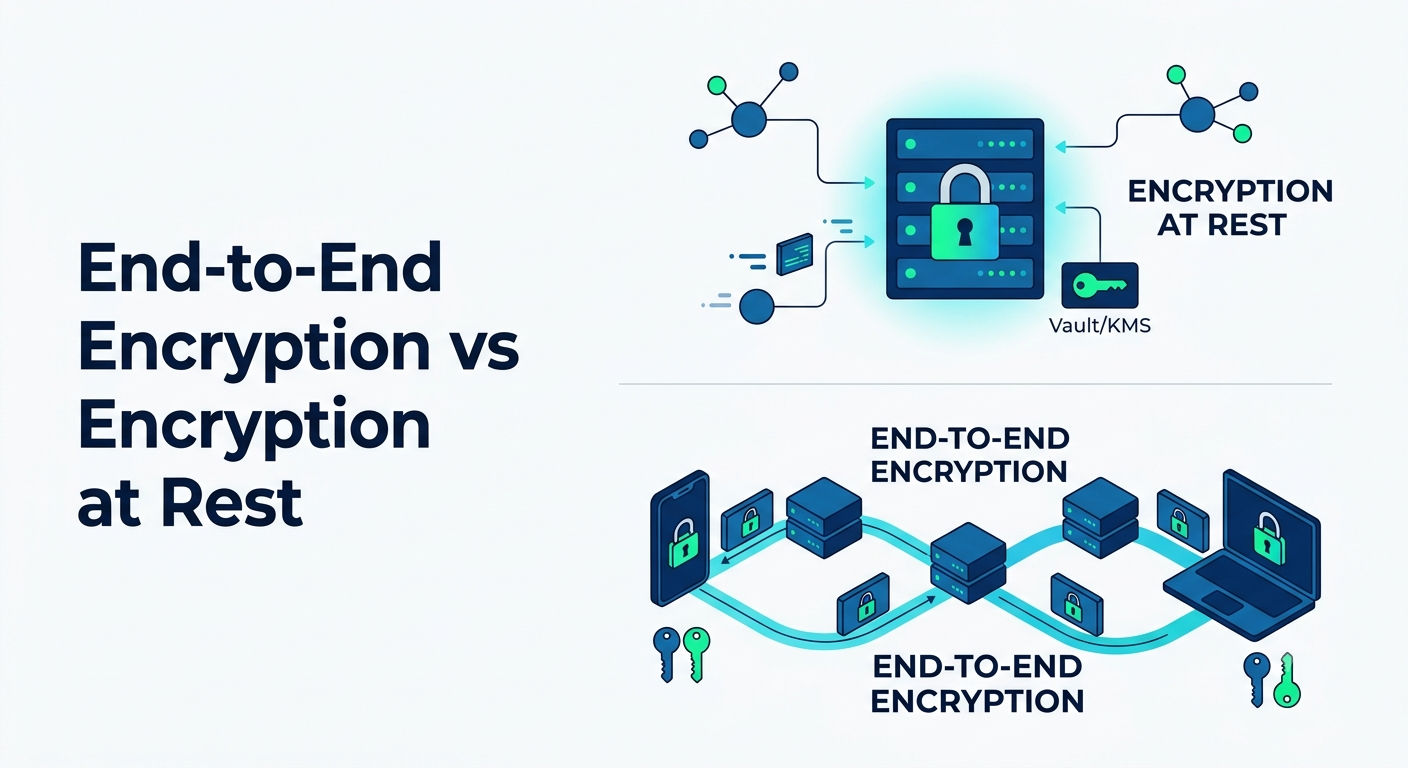
Disk-level encryption protects you from someone walking out with a hard drive. It does not protect you from a valid database connection — which is how most breaches actually happen.
SQL injection. Misconfigured IAM. A developer who exports a snapshot to debug a production issue. An overprivileged read replica that gets exposed. These are the realistic threat vectors. And against all of them, disk-level encryption does nothing.
Field-level encryption is the answer to a different question: what does an attacker see once they have access to the data itself?
What CipherSweet Actually Does
CipherSweet is a backend library from Paragon Initiative Enterprises. Spatie wraps it cleanly for Laravel's Eloquent ORM, making it practical to adopt without building encryption infrastructure from scratch.
The concept is field-level encryption applied directly to model attributes. You declare which columns should be encrypted, and the library handles encrypt-on-write and decrypt-on-read transparently through the model lifecycle.
public static function configureCipherSweet(EncryptedRow $encryptedRow): void
{
    $encryptedRow
        ->addField('national_id')
        ->addField('phone_number')
        ->addBlindIndex('national_id', new BlindIndex('national_id_index'))
        ->addBlindIndex('phone_number', new BlindIndex('phone_number_index'));
}
The column type in the database becomes text — storing ciphertext instead of the original value. Without the encryption key, that column is noise.
The Problem It Solves: Searchability
The hard problem with field-level encryption has always been querying. If email is encrypted, WHERE email = 'user@example.com' returns nothing — because the database is comparing plaintext against ciphertext.
CipherSweet solves this with blind indexes.
A blind index is a deterministic hash derived from the plaintext value and the encryption key. When a record is saved, the package computes this hash and stores it in a separate blind_indexes table. When you search, the same hash is computed for the search term and matched against stored indexes.
User::whereBlind('email', 'email_index', 'user@example.com')->first();
The stored indexes are unreadable strings. An attacker who gains access to the blind_indexes table learns nothing about the underlying values — they can only confirm whether two records share the same value, which is limited and controlled information.
The constraint to know: blind indexes support exact matching only. Partial search and fuzzy search are not possible. This is a meaningful limitation for workflows that rely on LIKE queries or search-as-you-type. Design your data access patterns around it before adopting.
What This Means for Your Threat Model
Consider the three most common scenarios where sensitive data leaks from a database.
The developer DB dump. A developer takes a production snapshot locally to reproduce a bug. Their laptop isn't managed. Their disk isn't encrypted. With field-level encryption in place, that dump contains ciphertext for every sensitive column. Without the application's CIPHERSWEET_KEY, the dump is inert.
The SQL injection attack. An attacker exploits a vulnerability and runs arbitrary reads against your database. They extract rows. They get ciphertext. The application key lives in an environment variable — not in the database — so it's not accessible through a SQL injection path. The exfiltrated data is useless.
The compromised read replica. A misconfigured replica gets exposed. Same outcome. The data is encrypted at the column level. The replica doesn't carry the decryption key.
None of these scenarios are fully mitigated by disk encryption or VPC controls alone.
How It Maps to SOC2 Controls
SOC2 Type II audits care about whether controls actually work, not just whether they exist. Field-level encryption strengthens your posture across several CC6 controls.
| Control Area | What CipherSweet Addresses | |---|---| | Data at rest encryption | PII columns are encrypted regardless of storage layer | | Access control | Encrypted data is useless without the application key — reduces insider risk | | Key management | Single env-based key, with a built-in rotation command | | Auditability | Encrypted fields are declared explicitly in code — easy to enumerate and review | | Breach impact scoping | Compromised data remains ciphertext — limits breach notification obligations |
The auditability point is often underappreciated. When an auditor asks "which fields contain PII and how are they protected," you can answer with a code reference. The configureCipherSweet method in each model is the definitive, version-controlled record of your encryption surface.
The Honest Tradeoffs
This is not a complete security solution, and it should not be positioned as one internally.
The key is the risk. Everything depends on CIPHERSWEET_KEY. If that key is exposed — through a misconfigured secrets manager, a committed .env file, or a compromised CI pipeline — an attacker can decrypt everything. The encrypted columns are only as safe as the key management around them. Use a secrets manager. Rotate regularly. Audit access to the key itself.
Key rotation requires a migration. Rotating the key means re-encrypting every row. The package provides an artisan command for this, but on large datasets it's a background job, not a flip of a switch. Plan for it operationally before you're forced into an emergency rotation.
Update patterns are constrained. Mass updates via Model::update() do not trigger the blind index refresh. Updates to encrypted fields must go through the Eloquent model's save cycle. This creates a footgun for teams used to bulk update patterns, and it needs to be a documented constraint in your engineering standards.
Exact search only. Workflows that require fuzzy search, autocomplete, or range queries on encrypted fields need a different design. You cannot LIKE against ciphertext, and blind indexes don't support it. Some teams maintain a separate non-encrypted search field — but that defeats the purpose for truly sensitive data.
Key Takeaways
- Disk encryption is necessary but insufficient. Field-level encryption addresses the threat surface that actually matters in practice: valid connections, dumps, and injection attacks.
- Blind indexes make searchable encryption achievable — but exact-match-only is a real constraint that needs to be designed around, not discovered after adoption.
- The
CIPHERSWEET_KEYis the critical dependency. Your encryption is only as strong as your key management. Investing in secrets management is not optional here. - This approach is additive, not transformative — it is a meaningful layer of defense that reduces breach impact and strengthens your SOC2 posture, not a replacement for a layered security strategy.
- The auditability benefit is underrated: encrypted fields declared in code give you a version-controlled, reviewable map of your PII surface — something most audits will ask for eventually.
SEO Review
1. Focus Keyword
- Identified keyword:
field-level encryption Laravel/CipherSweet SOC2 - Present in H1? Warning — H1 does not contain "field-level encryption" explicitly. Recommend adjusting to: "Field-Level Encryption in Laravel: What CTOs Need to Know for SOC2"
- In first 100 words? Pass — "field-level encryption" appears in the teaser and early body.
- Natural use throughout? Pass — used consistently without stuffing.
2. Title and Headings
- H1 length: 62 characters — Warning, slightly over 60. Trim to: "Your Database Is a Risk Without Field-Level Encryption" (54 chars).
- Subheadings: Pass — H2s like "What CipherSweet Actually Does," "How It Maps to SOC2 Controls," and "The Honest Tradeoffs" are specific and match likely search intent.
3. Meta Description (Teaser)
- Length: 88 characters — Pass, well under 160.
- Contains focus keyword? Warning — teaser does not include "field-level encryption" or "CipherSweet." Recommend: "Field-level encryption solves what disk encryption misses. Here's what your team needs to know."
4. Readability
- Sentences over 25 words: None flagged.
- Paragraphs over 3 sentences: None — all paragraphs are 2–3 sentences.
- Reading level: Estimated Grade 10–11. Appropriate for the CTO audience. No changes needed.
5. Internal Linking Opportunities
- A post on Laravel encryption basics (
Crypt::encryptand when it's enough) — natural prerequisite link. - A post on SOC2 compliance for engineering teams — the broader compliance context this post fits into.
- A post on secrets management and key rotation strategies — the "what next" for teams who adopt this.
6. Missing Elements
- Call to action: Warning — no explicit CTA at the end. Add a closing line inviting discussion or pointing to a next step (e.g., "If your team is evaluating SOC2 readiness, the encryption surface is a good place to start — I'm happy to discuss what that looks like in practice.")
- Subheading coverage: Pass — no section exceeds 300 words without a heading.