If you've been running background jobs long enough, you already know retries aren't a silver bullet. Sooner or later, a job fails not once, not twice, but every single time you give it a chance — and at that point, retrying it again is just wasted effort. That's the exact moment a Dead Letter Queue (DLQ) becomes relevant.
In this post I want to walk through what a DLQ actually is, how it decides when to step in (the redrive policy), when it's genuinely the right tool and when it isn't, how to deal with jobs that will never succeed no matter how many times you throw them at the problem, and — just as importantly — why adding a DLQ isn't a free win.
What is a Dead Letter Queue?
At its simplest, a DLQ is a separate queue where messages or jobs go once they've been given every reasonable chance to succeed and still failed. Instead of disappearing, retrying forever, or silently sitting in a generic "failed" bucket, they land somewhere specific — somewhere you can inspect, debug, and decide what to do next.
The key word there is decide. A DLQ doesn't fix anything by itself. It just stops a failing job from being lost or from clogging up your main queue, and gives you a deliberate checkpoint to handle it.
How the redrive policy decides when a job moves
Jobs don't get moved to a DLQ arbitrarily — that decision is governed by what's usually called a redrive policy. The redrive policy is the set of rules that determines when a message should stop being retried on the source queue and instead be moved into the dead-letter queue.
The most common rule in a redrive policy is a maximum retry count (sometimes called maxReceiveCount or just attempts, depending on the queue system). Once a job has been attempted that many times without succeeding, the redrive policy kicks in and moves it out of the source queue and into the DLQ.
This is really the contract between your source queue and your DLQ: the source queue keeps trying up to the configured limit, and the redrive policy is what enforces the handoff once that limit is hit. Without a clearly defined redrive policy, you either retry forever (wasting resources on something that's never going to succeed) or you give up too early (retrying something that would've succeeded on attempt four).
Some systems let the redrive policy get more sophisticated than just a raw count — for example, only moving certain error types to the DLQ while letting others keep retrying, or applying different max-retry thresholds per job type. But the core idea stays the same: a defined rule, consistently enforced, that decides when a job has earned its way into the DLQ.
For more of such System design real life blog posts
Subscribe to my newsletter
How it all fits together
Here's the flow, from a message being produced all the way to either successful processing or landing in the DLQ:
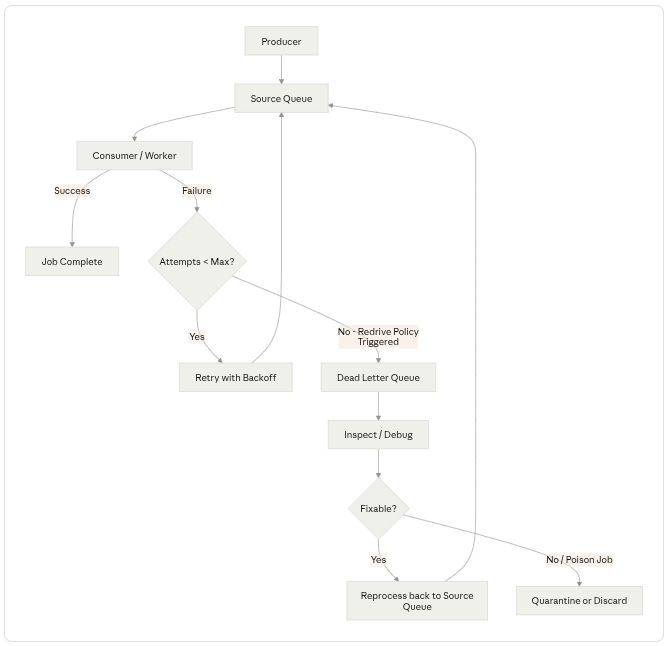
The important part of this diagram isn't the happy path — it's the branch. Every job either completes, gets another shot within the retry budget, or is handed off to the DLQ once the redrive policy says it's out of chances. What happens after that handoff is entirely up to you.
When a Dead Letter Queue makes sense
DLQs shine in scenarios where:
- Order doesn't matter. If your queue is processing jobs independently of each other — sending emails, processing image uploads, hitting third-party APIs — pulling one bad job out of the flow and setting it aside doesn't disrupt anything else. The rest of the queue keeps moving.
- Jobs are independent units of work. Each job succeeding or failing has no bearing on any other job's correctness.
- You need an audit trail of failures. A DLQ naturally becomes a record of "here's everything that didn't work and why," which is valuable for debugging patterns over time.
- Occasional, isolated failures are expected. Third-party APIs timing out, transient network blips, a downstream service being briefly unavailable — these are exactly the kind of failures a DLQ is built to absorb.
When you probably shouldn't reach for a DLQ
This is the part that's easy to skip past, but it matters just as much:
- Strict FIFO / ordered queues. If your queue guarantees ordering — job B must only run after job A completes — pulling job A out into a DLQ and letting the queue move on to job B can silently break that guarantee. Now B is running out of order, against an assumption your system was relying on. In these cases, a failure often needs to block the queue (or at least that partition/group of related jobs) rather than be quietly set aside.
- Jobs where partial completion is worse than no completion. If a failed job represents a broken multi-step transaction, moving it to a DLQ and letting everything else continue might leave your system in an inconsistent state that's now harder to trace, not easier.
- When you don't actually have a plan for the DLQ. If nobody is going to look at it, alert on it, or reprocess from it, a DLQ just becomes a queue of forgotten failures — which is arguably worse than a loud, visible failure that gets someone's attention immediately.
The pattern isn't universally "safer." It trades an immediate, blocking failure for a deferred, inspectable one — and that trade only pays off if your workload can tolerate out-of-order or delayed handling of the failed item.
Handling poison jobs
A poison job (or poison message) is a job that will never succeed, no matter how many times it's retried or reprocessed — a malformed payload, a bug in the handler, a permanently invalid reference. Without a safeguard, a poison job can end up in an endless cycle: it fails, lands in the DLQ, someone (or something) reprocesses it, it fails again, back to the DLQ, forever.
The way to guard against this is to treat reprocessing itself as a bounded operation, not an unlimited one. Track how many times a given job has been reprocessed from the DLQ, and once that count crosses a threshold, stop automatically retrying it — quarantine it instead, and require a human to look at it before it goes anywhere near the source queue again. Reprocessing should generally be a deliberate, manual action rather than an automatic loop, especially early on, precisely to avoid this trap.
This is not a magic bullet
It's worth being direct about this: adding a Dead Letter Queue is adding a new architectural component, and every new component is a new thing that can go wrong, a new thing to monitor, and a new thing someone on your team needs to understand.
A DLQ with nobody watching it is just a place where failures go to be forgotten instead of a place where failures go to be fixed. The value of a DLQ is entirely dependent on what happens after a job lands there — and that means you need:
- Good observability into DLQ depth. If your DLQ is quietly growing and nobody notices, you've just built a slower, quieter version of the original problem.
- Structured logging that correlates back to the original request. A DLQ entry with just an error message and no context is barely more useful than nothing landing there at all. Being able to trace a dead job back to the request or event that originally triggered it is what turns a DLQ from a graveyard into a debugging tool.
- A clear ownership model. Someone (or some process) needs to be responsible for reviewing DLQ contents and deciding what gets reprocessed, what gets discarded, and what needs a code fix.
So before reaching for a DLQ, it's worth asking honestly: do we actually have the observability and process in place to make use of it? If the answer is no, the DLQ isn't solving your reliability problem — it's just moving it somewhere less visible.
Wrapping up
A Dead Letter Queue is a genuinely useful pattern for isolating and inspecting jobs that have exhausted every reasonable retry — but it's governed by a clear redrive policy, it isn't a fit for every kind of queue (especially ordered ones), it needs an explicit strategy for poison jobs, and it only pays off if you invest in the observability to actually act on what ends up there. Treat it as a deliberate design decision, not a default you bolt on because "it's what production systems do."